Mahatma Gandhi
Watch this video for biography
Anti-War Activist (1869–1948)
Mahatma Gandhi was the primary leader of India’s independence movement and also the architect of a form of non-violent civil disobedience that would influence the world.
Synopsis
Born on October 2, 1869, in Porbandar, India, Mahatma Gandhi studied law and advocated for the civil rights of Indians, both at home under British rule and in South Africa. Gandhi became a leader of India’s independence movement, organizing boycotts against British institutions in peaceful forms of civil disobedience. He was killed by a fanatic in 1948.
Born on October 2, 1869, in Porbandar, India, Mahatma Gandhi studied law and advocated for the civil rights of Indians, both at home under British rule and in South Africa. Gandhi became a leader of India’s independence movement, organizing boycotts against British institutions in peaceful forms of civil disobedience. He was killed by a fanatic in 1948.
Early Life
Indian nationalist leader Mohandas Karamchand Gandhi, more commonly known as Mahatma Gandhi, was born on October 2, 1869, in Porbandar, Kathiawar, India, which was then part of the British Empire. His father, Karamchand Gandhi, served as a chief minister in Porbandar and other states in western India. His mother, Putlibai, was a deeply religious woman who fasted regularly. Gandhi grew up worshiping the Hindu god Vishnu and following Jainism, a morally rigorous ancient Indian religion that espoused non-violence, fasting, meditation and vegetarianism.
Young Gandhi was a shy, unremarkable student who was so timid that he slept with the lights on even as a teenager. At the age of 13, he wed Kasturba Makanji, a merchant’s daughter, in an arranged marriage. In the ensuing years, the teenager rebelled by smoking, eating meat and stealing change from household servants.
In 1885, Gandhi endured the passing of his father and shortly after that the death of his young baby. Although Gandhi was interested in becoming a doctor, his father had hoped he would also become a government minister, so his family steered him to enter the legal profession. Shortly after the birth of the first of four surviving sons, 18-year-old Gandhi sailed for London, England, in 1888 to study law. The young Indian struggled with the transition to Western culture, and during his three-year stay in London, he became more committed to a meatless diet, joining the executive committee of the London Vegetarian Society, and started to read a variety of sacred texts to learn more about world religions.
Upon returning to India in 1891, Gandhi learned that his mother had died just weeks earlier. Then, he struggled to gain his footing as a lawyer. In his first courtroom case, a nervous Gandhi blanked when the time came to cross-examine a witness. He immediately fled the courtroom after reimbursing his client for his legal fees. After struggling to find work in India, Gandhi obtained a one-year contract to perform legal services in South Africa. Shortly after the birth of another son, he sailed for Durban in the South African state of Natal in April 1893.
Indian nationalist leader Mohandas Karamchand Gandhi, more commonly known as Mahatma Gandhi, was born on October 2, 1869, in Porbandar, Kathiawar, India, which was then part of the British Empire. His father, Karamchand Gandhi, served as a chief minister in Porbandar and other states in western India. His mother, Putlibai, was a deeply religious woman who fasted regularly. Gandhi grew up worshiping the Hindu god Vishnu and following Jainism, a morally rigorous ancient Indian religion that espoused non-violence, fasting, meditation and vegetarianism.
Young Gandhi was a shy, unremarkable student who was so timid that he slept with the lights on even as a teenager. At the age of 13, he wed Kasturba Makanji, a merchant’s daughter, in an arranged marriage. In the ensuing years, the teenager rebelled by smoking, eating meat and stealing change from household servants.
In 1885, Gandhi endured the passing of his father and shortly after that the death of his young baby. Although Gandhi was interested in becoming a doctor, his father had hoped he would also become a government minister, so his family steered him to enter the legal profession. Shortly after the birth of the first of four surviving sons, 18-year-old Gandhi sailed for London, England, in 1888 to study law. The young Indian struggled with the transition to Western culture, and during his three-year stay in London, he became more committed to a meatless diet, joining the executive committee of the London Vegetarian Society, and started to read a variety of sacred texts to learn more about world religions.
Upon returning to India in 1891, Gandhi learned that his mother had died just weeks earlier. Then, he struggled to gain his footing as a lawyer. In his first courtroom case, a nervous Gandhi blanked when the time came to cross-examine a witness. He immediately fled the courtroom after reimbursing his client for his legal fees. After struggling to find work in India, Gandhi obtained a one-year contract to perform legal services in South Africa. Shortly after the birth of another son, he sailed for Durban in the South African state of Natal in April 1893.
Spiritual and Political Leader
When Gandhi arrived in South Africa, he was quickly appalled by the discrimination and racial segregation faced by Indian immigrants at the hands of white British and Boer authorities. Upon his first appearance in a Durban courtroom, Gandhi was asked to remove his turban. He refused and left the court instead. The Natal Advertiser mocked him in print as “an unwelcome visitor.”
A seminal moment in Gandhi’s life occurred days later on June 7, 1893, during a train trip to Pretoria when a white man objected to his presence in the first-class railway compartment, although he had a ticket. Refusing to move to the back of the train, Gandhi was forcibly removed and thrown off the train at a station in Pietermaritzburg. His act of civil disobedience awoke in him a determination to devote himself to fighting the “deep disease of color prejudice.” He vowed that night to “try, if possible, to root out the disease and suffer hardships in the process.” From that night forward, the small, unassuming man would grow into a giant force for civil rights.
Gandhi formed the Natal Indian Congress in 1894 to fight discrimination. At the end of his year-long contract, he prepared to return to India until he learned at his farewell party of a bill before the Natal Legislative Assembly that would deprive Indians of the right to vote. Fellow immigrants convinced Gandhi to stay and lead the fight against the legislation. Although Gandhi could not prevent the law’s passage, he drew international attention to the injustice.
After a brief trip to India in late 1896 and early 1897, Gandhi returned to South Africa with his wife and two children. Kasturba would give birth to two more sons in South Africa, one in 1897 and one in 1900. Gandhi ran a thriving legal practice, and at the outbreak of the Boer War, he raised an all-Indian ambulance corps of 1,100 volunteers to support the British cause, arguing that if Indians expected to have full rights of citizenship in the British Empire, they also needed to shoulder their responsibilities as well.
Gandhi continued to study world religions during his years in South Africa. “The religious spirit within me became a living force,” he wrote of his time there. He immersed himself in sacred Hindu spiritual texts and adopted a life of simplicity, austerity and celibacy that was free of material goods.
In 1906, Gandhi organized his first mass civil-disobedience campaign, which he called “Satyagraha” (“truth and firmness”), in reaction to the Transvaal government’s new restrictions on the rights of Indians, including the refusal to recognize Hindu marriages. After years of protests, the government imprisoned hundreds of Indians in 1913, including Gandhi. Under pressure, the South African government accepted a compromise negotiated by Gandhi and General Jan Christian Smuts that included recognition of Hindu marriages and the abolition of a poll tax for Indians. When Gandhi sailed from South Africa in 1914 to return home, Smuts wrote, “The saint has left our shores, I sincerely hope forever.”
When Gandhi arrived in South Africa, he was quickly appalled by the discrimination and racial segregation faced by Indian immigrants at the hands of white British and Boer authorities. Upon his first appearance in a Durban courtroom, Gandhi was asked to remove his turban. He refused and left the court instead. The Natal Advertiser mocked him in print as “an unwelcome visitor.”
A seminal moment in Gandhi’s life occurred days later on June 7, 1893, during a train trip to Pretoria when a white man objected to his presence in the first-class railway compartment, although he had a ticket. Refusing to move to the back of the train, Gandhi was forcibly removed and thrown off the train at a station in Pietermaritzburg. His act of civil disobedience awoke in him a determination to devote himself to fighting the “deep disease of color prejudice.” He vowed that night to “try, if possible, to root out the disease and suffer hardships in the process.” From that night forward, the small, unassuming man would grow into a giant force for civil rights.
Gandhi formed the Natal Indian Congress in 1894 to fight discrimination. At the end of his year-long contract, he prepared to return to India until he learned at his farewell party of a bill before the Natal Legislative Assembly that would deprive Indians of the right to vote. Fellow immigrants convinced Gandhi to stay and lead the fight against the legislation. Although Gandhi could not prevent the law’s passage, he drew international attention to the injustice.
After a brief trip to India in late 1896 and early 1897, Gandhi returned to South Africa with his wife and two children. Kasturba would give birth to two more sons in South Africa, one in 1897 and one in 1900. Gandhi ran a thriving legal practice, and at the outbreak of the Boer War, he raised an all-Indian ambulance corps of 1,100 volunteers to support the British cause, arguing that if Indians expected to have full rights of citizenship in the British Empire, they also needed to shoulder their responsibilities as well.
Gandhi continued to study world religions during his years in South Africa. “The religious spirit within me became a living force,” he wrote of his time there. He immersed himself in sacred Hindu spiritual texts and adopted a life of simplicity, austerity and celibacy that was free of material goods.
In 1906, Gandhi organized his first mass civil-disobedience campaign, which he called “Satyagraha” (“truth and firmness”), in reaction to the Transvaal government’s new restrictions on the rights of Indians, including the refusal to recognize Hindu marriages. After years of protests, the government imprisoned hundreds of Indians in 1913, including Gandhi. Under pressure, the South African government accepted a compromise negotiated by Gandhi and General Jan Christian Smuts that included recognition of Hindu marriages and the abolition of a poll tax for Indians. When Gandhi sailed from South Africa in 1914 to return home, Smuts wrote, “The saint has left our shores, I sincerely hope forever.”
Fight for Indian Liberation
After spending several months in London at the outbreak of World War I, Gandhi returned in 1915 to India, which was still under the firm control of the British, and founded an ashram in Ahmedabad open to all castes. Wearing a simple loincloth and shawl, Gandhi lived an austere life devoted to prayer, fasting and meditation. He became known as “Mahatma,” which means “great soul.”
In 1919, however, Gandhi had a political reawakening when the newly enacted Rowlatt Act authorized British authorities to imprison those suspected of sedition without trial. In response, Gandhi called for a Satyagraha campaign of peaceful protests and strikes. Violence broke out instead, which culminated on April 13, 1919, in the Massacre of Amritsar when troops led by British Brigadier General Reginald Dyer fired machine guns into a crowd of unarmed demonstrators and killed nearly 400 people. No longer able to pledge allegiance to the British government, Gandhi returned the medals he earned for his military service in South Africa and opposed Britain’s mandatory military draft of Indians to serve in World War I.
Gandhi became a leading figure in the Indian home-rule movement. Calling for mass boycotts, he urged government officials to stop working for the Crown, students to stop attending government schools, soldiers to leave their posts and citizens to stop paying taxes and purchasing British goods. Rather than buy British-manufactured clothes, he began to use a portable spinning wheel to produce his own cloth, and the spinning wheel soon became a symbol of Indian independence and self-reliance. Gandhi assumed the leadership of the Indian National Congress and advocated a policy of non-violence and non-cooperation to achieve home rule.
After British authorities arrested Gandhi in 1922, he pleaded guilty to three counts of sedition. Although sentenced to a six-year imprisonment, Gandhi was released in February 1924 after appendicitis surgery. He discovered upon his release that relations between India’s Hindus and Muslims had devolved during his time in jail, and when violence between the two religious groups flared again, Gandhi began a three-week fast in the autumn of 1924 to urge unity.
After spending several months in London at the outbreak of World War I, Gandhi returned in 1915 to India, which was still under the firm control of the British, and founded an ashram in Ahmedabad open to all castes. Wearing a simple loincloth and shawl, Gandhi lived an austere life devoted to prayer, fasting and meditation. He became known as “Mahatma,” which means “great soul.”
In 1919, however, Gandhi had a political reawakening when the newly enacted Rowlatt Act authorized British authorities to imprison those suspected of sedition without trial. In response, Gandhi called for a Satyagraha campaign of peaceful protests and strikes. Violence broke out instead, which culminated on April 13, 1919, in the Massacre of Amritsar when troops led by British Brigadier General Reginald Dyer fired machine guns into a crowd of unarmed demonstrators and killed nearly 400 people. No longer able to pledge allegiance to the British government, Gandhi returned the medals he earned for his military service in South Africa and opposed Britain’s mandatory military draft of Indians to serve in World War I.
Gandhi became a leading figure in the Indian home-rule movement. Calling for mass boycotts, he urged government officials to stop working for the Crown, students to stop attending government schools, soldiers to leave their posts and citizens to stop paying taxes and purchasing British goods. Rather than buy British-manufactured clothes, he began to use a portable spinning wheel to produce his own cloth, and the spinning wheel soon became a symbol of Indian independence and self-reliance. Gandhi assumed the leadership of the Indian National Congress and advocated a policy of non-violence and non-cooperation to achieve home rule.
After British authorities arrested Gandhi in 1922, he pleaded guilty to three counts of sedition. Although sentenced to a six-year imprisonment, Gandhi was released in February 1924 after appendicitis surgery. He discovered upon his release that relations between India’s Hindus and Muslims had devolved during his time in jail, and when violence between the two religious groups flared again, Gandhi began a three-week fast in the autumn of 1924 to urge unity.
The Salt March
After remaining away from active politics during much of the latter 1920s, Gandhi returned in 1930 to protest Britain’s Salt Acts, which not only prohibited Indians from collecting or selling salt—a staple of the Indian diet—but imposed a heavy tax that hit the country’s poorest particularly hard. Gandhi planned a new Satyagraha campaign that entailed a 390-kilometer/240-mile march to the Arabian Sea, where he would collect salt in symbolic defiance of the government monopoly.
“My ambition is no less than to convert the British people through non-violence and thus make them see the wrong they have done to India,” he wrote days before the march to the British viceroy, Lord Irwin. Wearing a homespun white shawl and sandals and carrying a walking stick, Gandhi set out from his religious retreat in Sabarmati on March 12, 1930, with a few dozen followers. The ranks of the marchers swelled by the time he arrived 24 days later in the coastal town of Dandi, where he broke the law by making salt from evaporated seawater.
The Salt March sparked similar protests, and mass civil disobedience swept across India. Approximately 60,000 Indians were jailed for breaking the Salt Acts, including Gandhi, who was imprisoned in May 1930. Still, the protests against the Salt Acts elevated Gandhi into a transcendent figure around the world, and he was named Time magazine’s “Man of the Year” for 1930.
After remaining away from active politics during much of the latter 1920s, Gandhi returned in 1930 to protest Britain’s Salt Acts, which not only prohibited Indians from collecting or selling salt—a staple of the Indian diet—but imposed a heavy tax that hit the country’s poorest particularly hard. Gandhi planned a new Satyagraha campaign that entailed a 390-kilometer/240-mile march to the Arabian Sea, where he would collect salt in symbolic defiance of the government monopoly.
“My ambition is no less than to convert the British people through non-violence and thus make them see the wrong they have done to India,” he wrote days before the march to the British viceroy, Lord Irwin. Wearing a homespun white shawl and sandals and carrying a walking stick, Gandhi set out from his religious retreat in Sabarmati on March 12, 1930, with a few dozen followers. The ranks of the marchers swelled by the time he arrived 24 days later in the coastal town of Dandi, where he broke the law by making salt from evaporated seawater.
The Salt March sparked similar protests, and mass civil disobedience swept across India. Approximately 60,000 Indians were jailed for breaking the Salt Acts, including Gandhi, who was imprisoned in May 1930. Still, the protests against the Salt Acts elevated Gandhi into a transcendent figure around the world, and he was named Time magazine’s “Man of the Year” for 1930.
The Road to Independence
Gandhi was released from prison in January 1931, and two months later he made an agreement with Lord Irwin to end the Salt Satyagraha in exchange for concessions that included the release of thousands of political prisoners. The agreement, however, largely kept the Salt Acts intact, but it did give those who lived on the coasts the right to harvest salt from the sea. Hoping that the agreement would be a stepping-stone to home rule, Gandhi attended the London Round Table Conference on Indian constitutional reform in August 1931 as the sole representative of the Indian National Congress. The conference, however, proved fruitless.
Gandhi returned to India to find himself imprisoned once again in January 1932 during a crackdown by India’s new viceroy, Lord Willingdon. Later that year, an incarcerated Gandhi embarked on a six-day fast to protest the British decision to segregate the “untouchables,” those on the lowest rung of India’s caste system, by allotting them separate electorates. The public outcry forced the British to amend the proposal.
After his eventual release, Gandhi left the Indian National Congress in 1934, and leadership passed to his protégé Jawaharlal Nehru. He again stepped away from politics to focus on education, poverty and the problems afflicting India’s rural areas.
As Great Britain found itself engulfed in World War II in 1942, though, Gandhi launched the “Quit India” movement that called for the immediate British withdrawal from the country. In August 1942, the British arrested Gandhi, his wife and other leaders of the Indian National Congress and detained them in the Aga Khan Palace in present-day Pune. “I have not become the King’s First Minister in order to preside at the liquidation of the British Empire,” Prime Minister Winston Churchill told Parliament in support of the crackdown. With his health failing, Gandhi was released after a 19-month detainment, but not before his 74-year-old wife died in his arms in February 1944.
After the Labour Party defeated Churchill’s Conservatives in the British general election of 1945, it began negotiations for Indian independence with the Indian National Congress and Mohammad Ali Jinnah’s Muslim League. Gandhi played an active role in the negotiations, but he could not prevail in his hope for a unified India. Instead, the final plan called for the partition of the subcontinent along religious lines into two independent states—predominantly Hindu India and predominantly Muslim Pakistan.
Violence between Hindus and Muslims flared even before independence took effect on August 15, 1947. Afterwards, the killings multiplied. Gandhi toured riot-torn areas in an appeal for peace and fasted in an attempt to end the bloodshed. Some Hindus, however, increasingly viewed Gandhi as a traitor for expressing sympathy toward Muslims.
Gandhi was released from prison in January 1931, and two months later he made an agreement with Lord Irwin to end the Salt Satyagraha in exchange for concessions that included the release of thousands of political prisoners. The agreement, however, largely kept the Salt Acts intact, but it did give those who lived on the coasts the right to harvest salt from the sea. Hoping that the agreement would be a stepping-stone to home rule, Gandhi attended the London Round Table Conference on Indian constitutional reform in August 1931 as the sole representative of the Indian National Congress. The conference, however, proved fruitless.
Gandhi returned to India to find himself imprisoned once again in January 1932 during a crackdown by India’s new viceroy, Lord Willingdon. Later that year, an incarcerated Gandhi embarked on a six-day fast to protest the British decision to segregate the “untouchables,” those on the lowest rung of India’s caste system, by allotting them separate electorates. The public outcry forced the British to amend the proposal.
After his eventual release, Gandhi left the Indian National Congress in 1934, and leadership passed to his protégé Jawaharlal Nehru. He again stepped away from politics to focus on education, poverty and the problems afflicting India’s rural areas.
As Great Britain found itself engulfed in World War II in 1942, though, Gandhi launched the “Quit India” movement that called for the immediate British withdrawal from the country. In August 1942, the British arrested Gandhi, his wife and other leaders of the Indian National Congress and detained them in the Aga Khan Palace in present-day Pune. “I have not become the King’s First Minister in order to preside at the liquidation of the British Empire,” Prime Minister Winston Churchill told Parliament in support of the crackdown. With his health failing, Gandhi was released after a 19-month detainment, but not before his 74-year-old wife died in his arms in February 1944.
After the Labour Party defeated Churchill’s Conservatives in the British general election of 1945, it began negotiations for Indian independence with the Indian National Congress and Mohammad Ali Jinnah’s Muslim League. Gandhi played an active role in the negotiations, but he could not prevail in his hope for a unified India. Instead, the final plan called for the partition of the subcontinent along religious lines into two independent states—predominantly Hindu India and predominantly Muslim Pakistan.
Violence between Hindus and Muslims flared even before independence took effect on August 15, 1947. Afterwards, the killings multiplied. Gandhi toured riot-torn areas in an appeal for peace and fasted in an attempt to end the bloodshed. Some Hindus, however, increasingly viewed Gandhi as a traitor for expressing sympathy toward Muslims.
Assassination
In the late afternoon of January 30, 1948, the 78-year-old Gandhi, still weakened from repeated hunger strikes, clung to his two grandnieces as they led him from his living quarters in New Delhi’s Birla House to a prayer meeting. Hindu extremist Nathuram Godse, upset at Gandhi’s tolerance of Muslims, knelt before the Mahatma before pulling out a semiautomatic pistol and shooting him three times at point-blank range. The violent act took the life of a pacifist who spent his life preaching non-violence. Godse and a co-conspirator were executed by hanging in November 1949, while additional conspirators were sentenced to life in prison.
In the late afternoon of January 30, 1948, the 78-year-old Gandhi, still weakened from repeated hunger strikes, clung to his two grandnieces as they led him from his living quarters in New Delhi’s Birla House to a prayer meeting. Hindu extremist Nathuram Godse, upset at Gandhi’s tolerance of Muslims, knelt before the Mahatma before pulling out a semiautomatic pistol and shooting him three times at point-blank range. The violent act took the life of a pacifist who spent his life preaching non-violence. Godse and a co-conspirator were executed by hanging in November 1949, while additional conspirators were sentenced to life in prison.
Death and Legacy
Even after his death, Gandhi’s commitment to non-violence and his belief in simple living—making his own clothes, eating a vegetarian diet and using fasts for self-purification as well as a means of protest—have been a beacon of hope for oppressed and marginalized people throughout the world. Satyagraha remains one of the most potent philosophies in freedom struggles throughout the world today, and Gandhi’s actions inspired future human rights movements around the globe, including those of civil rights leader Martin Luther King Jr. in the United States and Nelson Mandela in South Africa.
Even after his death, Gandhi’s commitment to non-violence and his belief in simple living—making his own clothes, eating a vegetarian diet and using fasts for self-purification as well as a means of protest—have been a beacon of hope for oppressed and marginalized people throughout the world. Satyagraha remains one of the most potent philosophies in freedom struggles throughout the world today, and Gandhi’s actions inspired future human rights movements around the globe, including those of civil rights leader Martin Luther King Jr. in the United States and Nelson Mandela in South Africa.
Mohandas Karamchand Gandhi
Gandhi [gaʹndi], Mohandas Karamchand, född 2 oktober 1869, död 30 januari 1948, indisk politiker och andlig ledare, ofta kallad ”mahatma” (stor ande).Gandhi växte upp i ett hinduiskt småstadshem i den lilla furstestaten Porbandar i nuvarande Gujarat, fjärran från tidens intellektuella och politiska strömningar. Familjen tillhörde baniakasten (köpmannakasten), men fadern var dewan (statsminister) hos fursten.
Gandhi blev redan 1881 bortgift med den jämnåriga Kasturbai (död 1944). Åren 1888–91 studerade han juridik i London. Han var blyg och försagd och blev andligen omtumlad av religioner och rörelser han kom i kontakt med, bl.a. teosofi och fabiansk socialism.
Efter misslyckade försök att etablera sig som advokat i Mumbai (Bombay) åtog han sig ett mål i Sydafrika, där han 1893–1914 blev den indiska minoritetens förkämpe mot de vitas diskriminering. Påverkad av bl.a. Tolstoj, Ruskin och Thoreau utvecklade han de icke-våldsmetoder och den enkla livsstil han sedan kom att fullfölja i Indien, dit han återvände 1915.
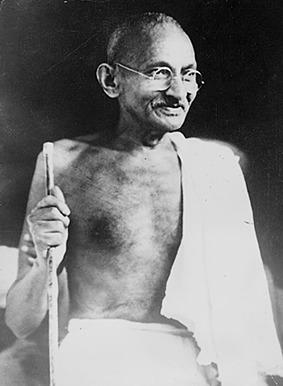
Mohandas Karamchand Gandhi kombinerade en yttre anspråkslöshet med djup bildning och en total inre kontroll.
Där indignerades Gandhi över förtrycket mot lågkastiga och fattiga och engagerade sig i tre lokala kampanjer mot ekonomiska orättvisor. År 1919 inledde han, provocerad av drastiska brittiska lagförslag, en kampanj mot det brittiska väldet i Indien. År 1920 länkade han samman muslimsk oro över den turkiske kalifens och de heliga platsernas öde efter krigsslutet (khilafatrörelsen) med hinduers och sikhers upprördhet överAmritsarmassakern i en icke-samverkankampanj med målet nationellt oberoende för Indien.
Efter Tilaks och flera andra ledares bortgång tog Gandhi ledningen för Indiska nationalkongressen, INC. Många indiska politiker ifrågasatte Gandhis idéer, men de insåg att han hade en speciell förmåga att uppbåda massornas, inte minst kvinnornas, stöd. Få förstod Gandhi när han 1922 avblåste hela den fredliga icke-samverkankampanjen för att en folkhop i en småstad tillgripit våld. Gandhis kommentar var att hans beslut var politiskt oriktigt men religiöst riktigt eftersom självstyrelse inte kan förverkligas så länge människorna behärskas av lidelser; den yttre friheten beror av den inre.
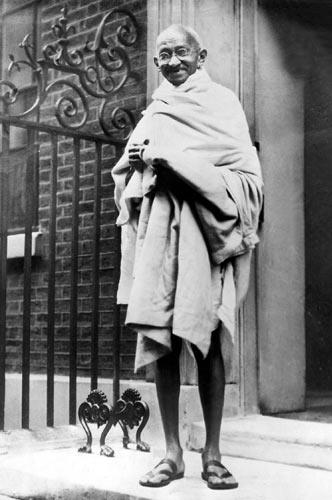
Mohandas Karamchand Gandhi utanför den brittiska premiärministerns residens 10 Downing Street i London. Foto från 1931.
I politiken använde Gandhi framgångsrikt religiösa begrepp och lättfattliga symboler som spinnrock, inhemskt handvävt tyg (khadi), böndernas traditionella höftskynke, enkelt leverne, bön, fasta men också t.ex. den av britterna pålagda saltskatten. ”Saltmarschen” 1930, då Gandhi och en skara anhängare vandrade över 40 mil till kusten för att där trotsa regeringsmonopolet och själva framställa salt, väckte enorm uppmärksamhet. Det var dock endast under kortvariga perioder, 1920–22, 1930–34 och 1940–42, som Gandhi ledde frigörelsekampen, som efterhand allt mindre präglades av icke-våld.
I sammanlagt sex år satt han fängslad. Han ägnade sig omväxlande åt politiska kampanjer, konstitutionella förhandlingar och social reformverksamhet. Indiens delning 1947 innebar ett stort bakslag för honom. Under sina försök att genom sin närvaro, genom tal, fastor och förhandlingar förhindra blodbad och skapa försoning mellan hinduer och muslimer mördades Gandhi 1948 av en hinduisk extremist.
För Gandhi var Indiens frigörelsekamp inte bara en politisk utan också en religiös akt och i sin finurliga politiska taktik använde han därför religiösa termer. Sanning är det centrala begreppet i Gandhis tankevärld. Den var för honom universums lag och det enda existerande, allt annat förde endast en skentillvaro. Det varandes natur är kärlek, det osannas, overkligas, är våld. Gandhis slutsatser härav blev grunden för hans agitationsteser: så länge indierna följer sanningen är de oövervinneliga. Seger över osanning kan vinnas genom vägran att samarbeta med den.
Gandhis politiska strategi byggde på en stark organisation (INC), symboler som folkmassorna förstod och ett konkret handlingsprogram. De metoder som skulle ge Indien självständighet (swaraj) var fredlig icke-samverkan (satyagraha, fasthållande vid sanningen), icke-våld (ahimsa) samt självförsörjning (swadeshi, det egna landet) och allas välfärd (sarvodaya).
Icke-samverkan inbegrep bojkott av brittiska varor, av ämbeten, domstolar och skolor, av armé samt av politiska val och församlingar.
Icke-samverkan kan utvidgas till ohörsamhet, som består i vägran att lyda orättfärdiga lagar och vägran att betala skatt. Sådan lydnadsvägran är, enligt Gandhi, effektivare än väpnat uppror.
Gandhi skilde mellan fredlig icke-samverkan som den starkes vapen och ”passivt motstånd” som den svages.
Sin tes om icke-våld byggde han på övertygelsen att intet varaktigt kan byggas på våld. Våld alstrar våld och förnedrar våldsmannen. För Gandhi var kravet på icke-våld absolut: icke-våld innebär att man inte ens får hysa en ovänlig tanke om någon. I begreppet självförsörjning och välfärd innefattade han att beslut decentraliseras, lokala produkter används och att inhemska skolor, domstolar osv. inrättas. Härigenom skapas självtillit och självaktning.
Dessa idéer omsatte han i riktlinjer för ett konstruktivt socialt program, som innefattade byutveckling, utveckling av småskalig industri och självförsörjande skolenheter som utvecklade både intellektuella och manuella färdigheter, ödmjukt tjänande och enkelhet. Med dessa utvecklingsstrategier strävade Gandhi mot erkännande av alla människors, inbegripet kvinnors och lågkastigas, lika värde. Han experimenterade ständigt och reviderade fortlöpande sina idéer. Medlen var också målet, ”mitt liv är mitt budskap”.

Mohandas Karamchand Gandhi, till höger, tillsammans med Indiens första premiärminister Jawaharlal Nehru, 6 juli 1946.
Gandhi var en politisk förnyare, dessutom en skicklig inspiratör, initiativtagare och förhandlare och för massorna en stor andlig ledare. Han var humoristisk och ömsint och kallades såväl ”bapu” (far) som ”mahatma”. I dagens Indien har politik och vardagsliv fjärmat sig från den av Gandhi utstakade vägen, men i den universella debatten är hans kamp mot rasism, kolonialism, våld och exploatering av natur och människor fortfarande aktuell.
Gandhi utgav tidningar, skrev böcker och otaliga brev. Hans samlade skrifter har publicerats i nittio band. Han har bl.a. utgivit Mina experiment med sanningen (svensk översättning 1929–30).
Litteraturanvisning
Judith M. Brown, Gandhi: Prisoner of Hope ( 1989);
R. Iyer (utgivare), The Moral and Political Writings of Mahatma Gandhi 1–3 ( 1986–87);
B.R. Nanda, Mahatma Gandhi: A Biography ( 1958).
Källangivelse
Nationalencyklopedin, Mohandas Karamchand Gandhi.http://www.ne.se/uppslagsverk/encyklopedi/lång/mohandas-karamchand-gandhi

Inga kommentarer:
Skicka en kommentar